Thursday, May 25, 2006

Chick Lit Through the Ages

“With their work routinely marketed with frothy cover illustrations and stamped “chick lit,” young, urban female authors struggle with a label that pushes sales as much as it undermines their efforts.” So reads the caption of Leah McLaren’s self-reflexive article about this new genre in June’s issue of Fashion magazine.


But is the genre of “chick lit” really new? Hasn’t “chick lit” existed since the inception of the novel, just in a slightly different form? (But, perhaps, marketed in a slightly different way?) And is this why I contained the novel moniker in non-committal quotation marks so many times in the previous 50 or so words?

A brief history of the novel: when humans began writing down their stories on parchment instead of cave walls, they often did so in the form of ballads, sermons, poetry and plays – forms to which illiterate access was easy. So with the move away from the authority of the Church and rise of the middle class around 1700, there came increasing literacy amongst this class and thus the rise of the novel. This is the argument of Ian Watt’s Triple Rise Thesis, which has been widely criticized for its assumptions, but will serve my simple purpose here.

Mary Shelley was one of the first female authors to write in the form of the novel; however, it was Jane Austen, who included several central female characters and their quotidian happenings in her novels of manners, who really started the “chick lit” genre. Austen’s novels include all the romance, negotiations of society and character growth that we see in many of the popular “chick lit” novels today.

Just as Catherine “greatly preferred cricket…to dolls” in Austen’s Northanger Abbey, and the title character in Emma enjoys such unladylike pursuits as archery, our modern day heroines like Bridget Jones do not fit the romantic feminine stereotype. We enjoy reading about slightly flawed characters (flaws that we may see in ourselves) who eventually stumble through the imperfections of life to prevail in the end (usually by landing a Marc Darcy or a Mr. Knightley). The reading is emotionally light, lacking in any heavy issues.

Compare this to the rise of the romance genre, with flowing hair and chiseled pecs on the pink and white covers, and the elaborately described scenes of love and loss on the pages inside. These novels work on ideas of perfect and flawless love. Their sole audience is women and their sole purpose is that of escape, with little critical analysis or thought needed.

So perhaps this is where “chick lit” veers from the more serious literature written by women. Virginia Woolf’s novels deal with homosexuality and suicide, Sylvia Plath’s deal with mental illness: their novels do include the female experience of traditional romantic relationships, but it is never the central theme. Lives tend to be less than ideal, the subject matter focussing on struggles that may not be solved in the end.

The same can be said of many contemporary (Canadian) authors – Margaret Atwood, Alice Munro, Sylvia Fraser, Ann-Marie MacDonald – these authors write from the perspective of “other”: marginalized members of society trying to negotiate their place within it. These stories are denser, pithier dissections of our so-called lives. They make us take a look at our imperfect existence and draw connections to ourselves.

Bridget Jones may have marked the shift from romance to “chick lit”: Helen Fielding presented us with a flawed character in an essentially romantically structured novel. She included elements of “perfect love’ from the romance genre with the idea of imperfect characters from weightier tomes. It is, perhaps, not as dark a reality as authors such as Atwood and Plath might illustrate, but still moves away from the idea of ideal, true love that follows a fated, effortless path.

Like Bridget Jones, the new, successful spring of pink and teal novels, set out pleasingly on tables in bookstores, combine the endeavour for perfection with the reality of “chick” life. McLaren may feel that the label undermines her efforts as a serious novelist (she has recently written The Continuity Girl, which I haven't read), but is she really writing about serious subjects?

Good literature, regardless of the author's gender, is engaging, thought-provoking and enduring. And these adjectives can be applied to any book, regardless of the gravity of the subject matter. Sometimes, all you need is to read about how Catherine lands Mr. Knightley. I'm sure Jane Austen would agree.

Wednesday, May 24, 2006

How Does a Teenage Boy Cross the Road?


Oh, how I hate that languid walk of teenage boys as they saunter across the street, slowing traffic with their invincible arrogance and over-sized pants. I fantasize about speeding up and driving into them, feeling the satisfying thud as their skinny bodies; no longer hard and impenetrable, but porous and delicate; hit the front end of my car and sail gracefully, slowly, to a soaring soundtrack, out of my way.

Saturday, May 20, 2006

Homer the Philosopher

Just as Simpsons devotees have been arguing for ages: The Simpsons is a forum for modern philosophical discourse, led by the great philosopher of our age, Homer Simpson. Read the full analysis as explored by philosopher Julian Baggini.

Thursday, May 18, 2006

What the Hell is on Joey's Head?

Like the line from the Nickleback song "Photograph," a similar question may be asked about the gentleman at left.

Why, after several drinks, do males feel the need to adorn their heads with improper and unbecoming headgear? Along with the pantyhose at left, I have seen underwear, pots, cardboard boxes and colanders atop the heads of men; beer usually in hand.

Is it a throwback to their manly hunting days, when they donned the antlers or hollowed out heads of their prey in order to lie in wait? Is it some kind of bizarre mating signal, indicating their readiness to procreate? (Lord help us if this is the case.)

Or is it just the drunken male thought process: "Whu-hoooo!!! Cheers! Let's drink! Hey...what's this? Oh man, this would look great on my head..."

Happy May 2-4. Go put something silly on your head.

Friday, May 12, 2006

Cycling in the City

Really, this is what life is all about: mild spring mornings, bike lane stretched out before you, a line of suckers idling in their cars as you sail past. Biking to work really makes you feel good. Not only are you stepping up to the One Tonne Challenge (Oh wait, wasn't that cancelled by the Conservatives? I guess we didn't need clean air in our atmosphere, anyway - oil production is way more important), but you are increasing your heart health and putting those endorphins into action first thing in the morning. Biking is reportedly the best way to travel within 10km in an urban centre (source: Green Living, Spring/Summer 2006): it's fast, it's free, and you don't get caught in traffic gridlock.

And here's one personal reason for biking to work. There is a piece of graffiti written on the road, within the boundaries of the bike lane (on Dundas, just west of Coxwell) that I pass by each morning I ride my bike. It's hard to tell in the picture at right, but the words spray-painted on the road read: "LOVE IS THE MESSAGE". This has provided me with inspiration and melted any stress or anger every morning I pass it. Maybe it's those endorphins, kickstarting my serotonin; maybe it's the fresh spring air; maybe it's the knowledge that I am not contributing to the destruction of our earth. But that little piece of urban poetry is my psalm, my bible reading of the morning that sets me up for a good day. I repeat it like a mantra as I ride over it.

Tuesday, May 09, 2006

Naturally Nude Naturists

Growing up in a family with parents from "the old country" and "across the pond," I have become well versed in the lexicon of the Brits. I know you eat biscuits, live in a flat, and chuck baggage in the boot of a car. A lift is an elevator, a jumper is a sweater, and bloody hell, you offer anyone a "cuppa" that pops 'round yours for a chat. I can even quickly translate "pants" for "underwear" and avoid any embarassing situation involving references to knickers.

But naturists for nudists?

The word "naturist" conjures up images of people in sunhats and binoculars, creeping through the woods; not images of saggy bums and well, other wobbly bits, laid bare on the beach.

"Naturist" seems like a modest, unassuming word that is used to describe a more conspicuous type of sunbather.

Monday, May 08, 2006

Gardening With the Environmentalists

With spring now in full force (is anyone else always amazed at how fast the city becomes so green?), the gardening enthusiasts of Toronto are lining up at Home Depots across the city to stock up on their Miracle Grow, their pansies and their gardening gloves. However, the one thing that amateur horticulturalists will not be able to pick up from any company this season, is a toxic dose of pesticides to kill off plants that are deemed “weeds” by our fickle society (for what is a weed, but a "a plant anywhere you don't want it?").

Is this really such a political issue that Denzil Minnan-Wong has had to come to the defense of his proud-gardening constituents of Don Mills who, since September of last year, have had to put up with the foul and feral blight of dandelions on their lawns? They ignore the links of pesticides to cancer and allergies, all for the vista of a green, unadultered lawn.

Personally, I agree with Deputy Mayor Joe Pantalone, who likes the yellow-topped herb: “If you like it it’s a flower, if you don’t it’s a weed. I think they’re like the forsythia in a way...one of the first signs of spring.” (see: pulse24.com for full article and a list of organic ways to be rid of weeds, should you choose).


Why do we feel the need to control nature to the point of pouring toxins into our soil for our children and pets to roll around in? Let’s think of our earth and the ecosystems that exist on it, not just the view from our lonely windows.

Tuesday, May 02, 2006

Gardening With the Conservatives

So, the Conservatives brought out their federal budget today, complete with a whole percent taken off our GST (now how will us Ontarians calculate the tax in our head? 15% was so easy…). And like true, blueblood Tories, all the tax cuts benefit those of us who make over $36 000, or some such comfortable number.

And their biggest folly, according to moi? This childcare credit, $1200 for parents to spend as they see fit.

Well, that’s the problem with society, you see. Not all parents see fit. This is not a rant about the misspending of that money. I’m sure many parents are happy to receive a grand from the government and will spend it responsibly. But like the Conservatives’ clamp down on crime by rounding up the criminals and givin’ ‘em longer sentences, the Tories’ about turn from national daycare connects nicely with my gardening metaphor: it cuts the weed at the stalk, temporarily removing the bad stuff - all that work and money into a national daycare programme - and ignores the roots – the healthy and vigourous development of our children.

We are seeing the results of all those Harris cuts to social programmes back in the 90s with more guns being shot off by misguided youth, failed by social programmes and trapped in poverty. Harris got rid of the weeds, but the roots remained firm and are now growing up.

I worry that this move away from national daycare will add to our social problems. If we had a nationally funded daycare programme, it would not only allow parents to work without paying half their salary to daycare, it would provide the early childhood education that is so vital and critical. I see the effects not only of ill-parenting, but of uninformed parenting everyday at my school. I see students that have never encountered a book before kindergarten, aren’t familiar with a horse or cow, don’t know how to share toys, or have never sung a song. I’ve met kids that haven’t ventured further in this city, than to the store, a hundred metres up their street.

If we want our children to grow up to be sound, contributing citizens of our society, this education doesn’t begin at school. It begins at birth. And only recently have government agencies begun initiatives based on this idea (Parenting Centres and Early Childhood Centres have popped up around the city). But these are only accessible to those who choose to seek them out. Universally funded daycare is an incentive for parents to enroll their children and then see the vast benefits of early childhood experiences.

Sunday, April 30, 2006

Suburban Madness

I have always been interested in the idea of proxemics, first introduced to me in an anthropology course. Proxemics deals with the social construction of personal space – how close we stand to each other and how this changes with the situation. If you’re North American or Northern European, you probably stand closer to a friend at a bar and further away from a client when discussing business. Proxemics also extends to how we construct our space as a culture. North Americans have the “buffer zone” of a front hall when entering a house. In Cuba, the front door of most houses opens straight into the living room.
So I always find it interesting to “deconstruct” how space is used. And a recent exhibit at The Toronto Free Gallery about Suburbia got me thinking about how suburbs use space.

It has been said before, but the suburbs are built around the mighty automobile. My visits to Ajax have shown me outdoor malls where the space assigned to parking lots out-measures the retail space by a ratio of at least 4:1. And these clusters of massive Wal-Marts, Old Navys and Best Buys are set far enough away from the residential masses of cookie-cutter houses attempting individuality through variations in colour and orientation of layout, that a car is “required” in order to “pop ‘round the shops.”

Now let’s take a look at those mass-produced, lower selling price, but-still-accessible-to the-city (by car, of course, or by train, but you have to drive to the train station) houses that dot the suburban landscape. What is the most prominent feature of the house? The sweeping bay window? The detailed brickwork over the door frame? The carefully-placed stained glass in the front room window? No, it’s the garage, front and centre in many suburban houses. And a lot of garages have space for two or more cars. During my time in England, I noticed that garages were not a required part of housing and were often tacked on well after the house was built. As much as they moan, the British have a better and more comprehensive transit system than we do in Canada, therefore houses do not need to be built around housing a car.

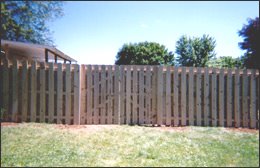
The priority of the automobile aside, it was something different in the Toronto Free Gallery’s exhibition that got me onto proxemics. One piece was an enclosure of six-foot privacy fencing (like the kind shown at left), the inner contents visible only in snippets as you tried to peer through the small lines of open space between the slats. The idea was exactly as the name of the fencing indicates: the attainment of privacy. And when I boldly opened the latch to the installation (still not sure if this was intended), I caught a glimpse of a naked female torso cast in stone.

They say that high fences make good neighbours, a saying that must be uniquely North American/European. I bet the Cubans have a slightly different maxim: easily accessible family rooms with no neutral space make for good neighbours.

Although it probably sounds better in Spanish.

Wednesday, April 26, 2006

April Anniversaries: Not Just Earth Day


(from news.bbc.co.uk)

Today marks the twentieth anniversary of the world's worst nuclear accident at Chernobyl. Pripyat (pictured), once a city of almost 50,000 inhabitants, has sat abandoned since then. It took authorities several days to report the disaster and take measures to keep people safe. It has been years that scientists have been telling governments, the media and the public that our current levels of consumption are putting our entire planet at risk. Are our children to become painted shadows?

Saturday, April 22, 2006

Penny Lame

When you bring your own bags to Loblaws, they give you a one cent discount for each bag. So when my bill came to a round eight dollars today, the cashier took off 2 cents for my two cloth bags. I then had a pair of jangling pennies in my pocket, of little use, except to make exact change.

I grew up with the saying “a penny saved is a penny earned,” but I think we may be at the point, with inflation and modern society, that a penny just isn’t really worth anything anymore.

If I took each penny that I deemed “worthless” in my life, and pooled them, I’d probably have about 700, which over my entire life, is $7. If you look at the big picture you could say that in a city of 3 million, with each citizen saving $7, the cast off pennies would amount to a lot of money. But that abstract amount is automatically put back into the nebulous fray of the city on a daily basis when you leave your "worthless" pennies at convenience stores, in your change at a restaurant, or mistakenly behind couches.

Australians and New Zealanders don’t have coinage below 5 cents anymore. (They also have a high number of residents who feel no pressing need to don footwear in town - but that’s a different post.) What a lovely, laid back way of being! All prices are quoted to the nearest nickel and if something is sold by weight, shopkeepers round up or down from the calculated price.

The Kiwis and Aussies were ahead of the mark in giving women the vote and they are consistently ahead with educational theory and practices. Could they be ahead when it comes to shrapnel in our pockets?

Friday, April 21, 2006

David Miller's Clean Sweep Army


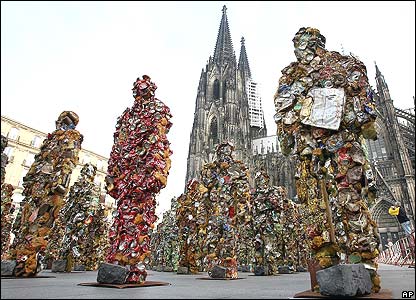
While Torontonians took 20 minutes today to clean up the city, one thousand "trash people" sculptures by artist HA Schult stood outside Cologne Cathedral in Germany.

Does that one on the right remind anyone of David Miller?

(from news.bbc.co.uk)

Thursday, April 20, 2006

Googlicious


I love this about Google: they change their logo to reflect whatever celebration is happening. They had a whole series of logos during the Olympics, they commemorated Groundhog Day with little rodents climbing over the letters, and St. Patrick's Day saw Google's logo in green with decorative shamrocks. Today the logo is in the style of the art of Miro, the Spanish painter who was born on April 20th. Usually I pick up on the celebration immediately, but today I had to google "miro april 20" to figure out the connection.

What happens when two events are celebrated on the same day? And what will be the logo on Sunday, Shakespeare's birthday?

Tuesday, April 18, 2006

Long Road


Afghans return to their homes after a day's labour in Kabul.
(from news.bbc.co.uk)

Monday, April 17, 2006

Fitted Sheets and Full Toilets

I am very much unlike Maggie, the maid from Newfoundland with whom Jan Wong is partnered in her series on working as a maid in Toronto. Maggie seems to enjoy cleaning: she’ll remove hair from a hairbrush, pluck dead petals from flowers in vases, and she actually knows how to “fold a fitted sheet into a neat square” (I didn’t think that was physically possible). I may get the urge to clean my apartment thoroughly maybe once a quarter – a frequency that is slightly unhygienic and certainly slovenly.

However, cleaning my home does occur more often than four times a year (I’m not a total slob). But it is usually rushed, with several areas ignored, and usually happens when there are people coming over, which is why there was a while when I considered having some sort of cleaning service. But I couldn’t get over the middle class guilt of someone else cleaning up my soap scum and sucking up my dust and dead skin cells. And Jan Wong’s piece has made me realize why I have this guilt.

Ms. Wong is quick to point out that there is a difference between house cleaning companies where the employees tend to be Canadian-born women with little education, and entrepreneurial individuals who tend to be highly-educated immigrants. When you pay an entrepreneur $80 to clean your house, they get the whole fee. When you pay a cleaning company, the maid sees very little of that. And so, people who don't have the means to work for themselves, remain trapped in a cycle of poverty and class oppression.

What disturbed me most, though, was the treatment received by the maids at the hands of the clients. They were supposed to be invisible, some ugly necessity that was tolerated to get a nasty job done. They weren’t allowed to talk, or use the clients’ bathrooms. Their presence was basically ignored, unless there was some sort of foul job to be done: there is a rule that maids do not have to touch undergarments, however Ms. Wong was faced with a toilet full of urine and feces to clean, and in one case, a client left dog poo on the floor for two days because they knew the maids were coming. What is the criteria for these invisible lines of acceptability?

I think (I hope?) the individual stories that Jan Wong relates are the worst of the bunch. I have several friends who employee cleaners (none employed by a cleaning agency), who keep their houses in neat order and would never leave animal or human waste for someone else to clean up. And if you have the money, but not the time, it is a personal choice to pay someone to clean your house.

But there is a line of acceptability, which is drawn at different points for different people, as to what is appropriate for a “domestic” to do. Folding sheets neatly into a square? No problem. Cleaning an unflushed toilet? Dodgy. Picking up pet shit? Crossing the line.

Saturday, April 15, 2006

Too Many Pillows

I have been following Jan Wong’s series on her experience living below the poverty line, in the Globe and Mail, and some of the revelations about the way people live and behave are astonishing. More on that later. First, I want to address an observation she made while cleaning a monster home in Thornhill about “21st century conspicuous consumption: 14 useless, little polyester pillows of various shapes and sizes piled on top [of a bed].”

Why do we need so many pillows?

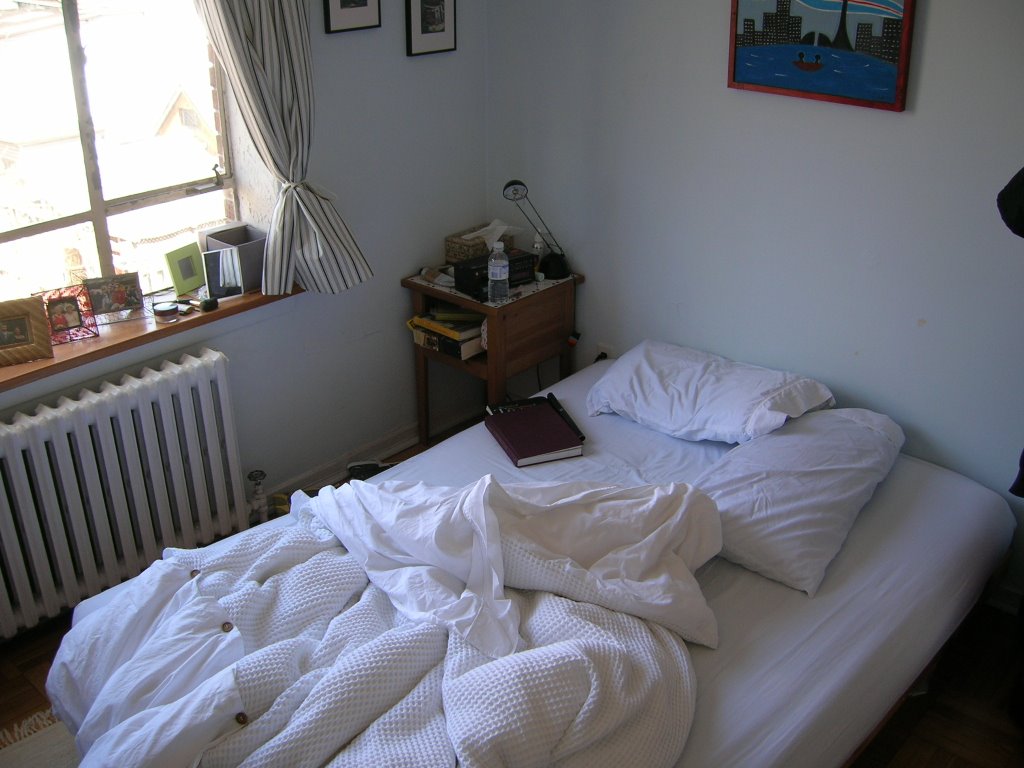
I realize that my priorities (and disposable income) may be slightly different than the average 3-person family living in a 2000 square foot home with five bedrooms, four bathrooms etc. I do not place a high value on perfect bedroom presentation. In fact, I do not place a high value on perfect presentation anywhere in my life (anyone who’s seen me scrambling into work, late, with pillow creases on my cheek, will agree). I would much rather have my bed easily accessible when I fall into it, ready for sleep (see right: my bed as it was left this morning). I don’t want to be wasting my time removing pillows for the same reason I leave my box of cereal on my kitchen table: why add the extra step of opening a cupboard door in the morning?

I understand the need to have things in order and in their place. And I understand the need for things to look visually pleasing (I make my bed when guests come over). I also understand the need for pillow support when in bed. But 14 useless pillows?!

Unless you’re hosting a serious pillow-fight, that many pillows is completely over-the-top.

Tuesday, April 11, 2006

Worried? Have a Mushroom...

American scientists are re-testing the medical benefits of psychedelic drugs, finding that drugs like psilocybin (found in “Magic Mushrooms”) help patients cope with anxiety. Hallucinogenic drugs like psilocybin and LSD used to be prescribed to treat various psychiatric disorders in the 50s and 60s, before being banned as the drugs became popular recreationally.

So what deems a drug worthy of being outlawed? Why are amphetamines okay to prescribe to ADD children, but illegal for adults to buy? Why was cocaine an acceptable ingredient at the turn of the century but is now demonized by governments around the world? Why is alcohol, by far the most socially destroying drug to those who become addicted, legal and socially accepted?

In the BBC article about LSD, it states that the drug quickly became illegal when counter-culture started using it recreationally. And it seems that this is why so many drugs are controlled and made illegal: they’re fun.

Now here’s the disclaimer about addiction: I understand the gravity of this disease and I do see it as a disease. By making certain drugs illegal, governments are trying to cut down on addiction and other societal ills that come with drug abuse. But this is a sweeping judgment on the mass population, a high percentage of which will not find themselves addicted to much more than coffee in their lifetime.

Humans use drugs for a variety of medicinal reasons, and some of the legal drugs are far worse for the body than the illegal ones, especially because most illegal drug users (I am not including drug abusers) use drugs on a less regular basis than people on prescriptions.

It seems that society’s views on illegal drugs have more to do with built up attitudes (by government propaganda, by the media) than scientific evidence of long term and short term effects. And if society sees that a drug’s sole purpose is for recreational use, then it will ban it.

Everything in moderation, people.

Monday, April 10, 2006

"To repeat what others have said, requires education; to challenge it, requires brains." ~ Mary Pettibone Poole

Saturday, April 08, 2006

Whine Culture

In this Saturday’s Globe and Mail, columnist Karen Von Hahn writes about the growing occurrences of people in the service industry complaining to their customers. She relates a story involving a flight attendant quipping to her, the passenger, that he had not sat down for the entire flight and hadn’t even been able to get a drink of water.

Now, I generally smirk when I read Karen Von Hahn’s column, entitled “Noticed”. I smirk because whatever societal trend she “notices,” is something that the rest of the world noticed six months previous (distracted drivers, quotes on Starbucks cups, and Napoleon Dynamite, for goodness sake!). However, I have to agree with her on this one.

Unless you are a close friend about to unload some psychic issues, the only answer to my question, “How are you?” should be: “Fine, thanks!”

I had a rather negative experience at a downtown restaurant recently when a few friends and I had to wait for a table, despite the fact that we had a reservation. When we were finally seated, we actually had to ask for the wine list and then ask to order a bottle. The harried waiter came over and mumbled something about “getting slammed” and being short a server as he took out his notepad, failing to make eye contact. We hadn’t even asked him how he was.

I understand that the food service industry is a high-stress job at busy times (I’ve been a server), and I understand that serving people in a small, metal tube, 35 000 feet in the air is not the most relaxing of activities, but why people think that unloading their problems/excuses/stresses is appropriate employee-customer discourse is beyond me.

What Ms. Von Hahn’s flight attendant should have done, was smiled, topped up her glass of wine and then gone to complain to a fellow staff member. What I might have done, had I been in the columnist’s shoes, was gently remind the flight attendant that it was I who was paying a grand for this experience, and he who was receiving a wage for the experience.

But then I might get “noticed” as one of those bitchy customers who enjoy criticizing underpaid customer service representatives. I’ll stick to being a bitchy blogger.

  • Karen Von Hahn: Noticed
  • Tuesday, April 04, 2006

    Canadian Television

    Over the past 26 hours, I have seen three Canadian politicians on my television screen, all performing in slightly different roles.


    Last night was a repeat of Corner Gas in which Paul Martin guest starred in the opening scene, playing the straight man to Brent Butt’s, uh, straight man. This evening, Sam Sullivan, Vancouver’s mayor, spent some time hiking and talking disabilities with Rick Mercer. And as I post this, Peter Mansbridge will be interviewing Stephen Harper.

    When compared to our neighbours to the south, it is impressive that our actual Prime Minister had a guest spot on a top-rated sitcom. There’s no way you would see Georgie B. doing a walk-on for Will & Grace. And it was refreshing to see Vancouver’s quadriplegic mayor having no reservations about poking fun at his disability. Too many viewers might be upset by the insensitivity in the States (and actually call the network to complain, like so many did when Janet Jackson’s boob popped out).

    Now let me diverge for just a moment: Pamela Anderson hosting the Junos. She made several dodgy comments that would have been bleeped had the show been aired in the States – comments about Michael Buble´ making her hot, getting some Hedley and Alan Doyle in a G-string, among others I’ve forgotten.

    And this is what I love about Canadian television: it’s not caught up in religious morals and political appearances. When The Kids of Degrassi Street did a show on homosexuality all those years ago, nobody batted an eyelash, but my god, Ellen coming out on TV was a major left step forward for the Yanks. And while Bush limits his television appearances to awkward exits and serious State of the Union addresses, Paul Martin cracks jokes with Brent Butt and schmoozes with Bono.

    Now if only we could get Stephen Harper to take himself a little less seriously. (Is a combat vest really needed on a diplomatic trip to Mexico?)

    Sunday, April 02, 2006

    Lost in a Television Formula

    My first experience with the television show Lost was in a hotel room in le Marais. There were only a few options - CNN and local French channels, one of which was airing Lost, en Francais. I struggled to understand the French, never mind the fact the characters were jumping between the island and their previous lives. I gave up quickly and switched the channel to CNN.

    My next experience with Lost was easier linguistically, but just as difficult semantically. My previous knowledge of Lost was that a plane had crashed and the people were trying to survive. And all of a sudden there was an underground room and a set of numbers and some computer thing that had to be reset every 67 minutes or whatever. Je suis perdue, I said and switched the channel.

    Well, now I am making a concerted effort to understand this show. I have rented the first season of the show so I can catch up on all the question marks that pop up over my head when I watch new episodes.

    I’m not bowled over by the show, in fact, I find some of the writing and acting quite awkward and unnatural at times. And some of the plot lines are so far-fetched as to be tiresome. (Polar bears grabbing pilots out of cockpits and depositing them bloodied, into trees? Was that ever explained?)

    However, the show presents an interesting hybrid of television trends: reality shows such as Survivor and crime solving shows such as CSI.

    The creators of Lost have taken the premise of a number of very different personalities forced to live together, and combined it with the twists and turns of crime and mystery programmes where the characters (and the viewers) are trying to figure out just what went on. Lost has performed so well in the ratings because the two most popular types of television formulas have been fused into one ratings winner.

    What will be interesting to see is the next shift in television popularity: will Survivor-type shows fizzle, followed by Lost? Or will the viewing public tire of the hyperbolic storylines and fanciful characters that permeate this Wednesday night show?

    Or, will Simon Cowell create a mega-show which consists of a group of American Idol hopefuls, stranded on an island, competing for resources AND solving a set of complicated mysteries. Britney Spears could guest-star.

    And if we ever get to a point where that type of show gets airtime, send me back to that Paris hotel room with 4 channels. I’ll walk out the door and experience my own version of real life.

    Saturday, April 01, 2006

    Hampstead, March 25th

    Gwen has chosen a tapas bar this time, an easy tube ride down the Northern Line from her house in Hendon. Lyla’s journey has taken a little longer – she checks her watch as she walks up the massive escalator, her body feeling slightly spectral at the speed she glides past adverts for west end shows and travel insurance. She’s five minutes late and Gwen will silently notice this fact.

    It takes a moment for Lyla to get her bearings as she emerges from the station. The evening light is dwindling, slowly encompassing figures in black and grey coats, making their way home. She eyes the Starbucks, Gwen’s marker, and walks towards it.

    Gwen is seated at a table near the front, back rigid, book in hand. It is a ritual she picked up at university with Lyla, who was constantly 15 minutes late for everything. Gwen was always 10 minutes early and therefore needed some form of entertainment while she waited. She looks up as Lyla throws her coat over the back of the chair, her eyes hard and calculating for a split second before melting into warm recognition.

    “Lyla! How are you?” She half-stands to receive Lyla’s kiss, “Trouble on the tube?”

    “Can never rely on London transport,” responds Lyla, sucking in her breath as she sits down.

    “How’s Sam?” she asks, eyebrows raised, eyes wide.

    “He’s well. Working hard, as always.”

    “Do you remember that horrible Charles I went out with just before I met Lucas?” Gwen’s eyes drop to her wedding and engagement rings on her left hand and she swirls them around her finger. “He was always working. At least that was his excuse. It was such a relief to find Lucas who actually made time for me!”

    She leans forward in her seat and looks back up at Lyla, a half smile on her face. Lyla holds her gaze for a moment too long, so that the silence is uncomfortable.

    “Oh, not that I’m saying that about Sam, darling!” Gwen breaks the hush, her face becoming animated.

    “Oh, I – I didn’t take it that way,” replies Lyla, just as the waiter arrives at their table.

    “Ladies, something to drink?”

    Their necks elongate as they turn their collective attention to the waiter. Gwen is the first one to turn her gaze back across the table.

    “They have a fabulous Spanish tempranillo here,” she says, bright-eyed and chirpy.

    “Sounds great,” says Lyla as she meets Gwen gaze. Lyla smiles and reaches for the menu.