Showing posts with label environmental issues. Show all posts

Saturday, September 13, 2008

Gas Is Not Food, People


I loved watching all the outraged drivers on the news last night react to the 13 cent jump in gas prices. There were accusations of price-gouging and calls for the government to cut taxes to help out the drivers of Toronto who, generally unaccompanied, negotiate over-sized, gas-guzzling vehicles through the plodding lanes of our city. Maybe I don’t fully understand their plight, as my car (a small, fuel-efficient Tercel) spends most of its time parked behind my building: I walk to work, bike for groceries and take public transport downtown the majority of the time.

But come on – these drivers are relying on a finite resource, the burning of which has contributed to the climate change of our earth. You should be paying more.

In Britain, the price of gas is approximately twice what it is here (and has been for the last ten years I’ve been keeping track). And most Britons drive small, fuel-efficient cars. And way more of them rely on public transport (I know – Britain is better serviced by trains and such, but it is because there is demand for it). Europeans seem much more willing to change their habits if something is expensive.

North Americans don’t want to consider any alternative to sitting alone in a comfortable car for 2 hours a day to get to and from work.

Sometimes driving makes more sense than other forms of transport. I get that. I drive if it’s raining or to a friend’s house if it's not well serviced by the TTC. But each time I get in that car, it is a conscious decision where I have weighed the other transport options.

UN Secretary General Ban Ki-Moon commuted to work in a solar-powered taxi this past week to raise awareness about alternatives to fossil fuels. That’s all I’m asking. Think about alternatives. The old vehicular standby is not our only option.

Tuesday, August 12, 2008

Blue Box Blues

Is the city of Toronto really this stingy?

City officials are planning to crack down on people scavenging recyclables from blue bins. According to Toronto's Solid Waste Department, once the blue bin and its contents are curbside, the whole kit and caboodle is city property and they don't want anyone sorting through it.

You see, the city makes quite a bit of money off our aluminum cans ($2000 per tonne). Fair enough, but are these scavengers nicking empty pop cans? Anecdotal evidence (in the form of a couple of neighbourhood characters armed with shopping carts of varying constructions) shows that the scavengers are looking for wine and beer bottles. A cartful of finished Merlots and Tempranillos can net a tidy sum, especially in affluent neighbourhoods like mine where homeowners spend a lot on alcohol and can’t be bothered to make the trip to the Beer Store to return bottles.

(In the Beach, where I live, there are two LCBOs within walking distance of a large number of residents, including myself; however the Beer Store is a farther trek and therefore requires a bit more forethought than my usual, “Am I out of rosé? I think I’m out of rosé… I’ll just duck in for a bottle of rosé.” If the Liquor Store took back bottles, I could employ the empty one in, full one out method, based on the cold beer out, warm beer in method of university bar fridge drinking. But of course, the rosé bottles add up and require a large, strong bag in which to carry them, and a vehicle in which to transport them when there are too many in my kitchen cupboard not to be ashamed about.)

Why shouldn’t we let the enterprising unemployed continue with the sifting? Clifford Orwin compares it to the “biblical practice of gleaning”:
Leviticus 19.9 commands leaving the corners of one's fields unreaped so the poor can harvest them: One should never enjoy one's abundance to their exclusion. Similarly, I leave for the poor 20 cents of the value of every bottle of wine I buy. Collecting the bottle is their form of gleaning, and like gleaning in biblical days, it takes considerable labour.

There was a time when a city councillor wanted to ban panhandling: they found it somehow offensive, the homeless and unemployed sitting and begging for money. It annoyed people to be asked for money, to be reminded that we live in a many-tiered society, despite our many social nets. Why can't they get a job, asked some rather unempathetic citizens of our city.

Well, some have found jobs – jobs that don’t bother anyone (someone complained about the noise of scavengers, but give me a break – the industrial lawnmowers that rage at 8 o’clock in the morning outside my window are way worse) and help to support the province’s bottle return programme.

The City needs to stop worrying about who is returning my empty bottles of rosé and start worrying about more pressing issues.

Sunday, March 23, 2008

Baby, You Can Drive (in) My Car

A few weeks ago on CBC’s Metro Morning, Andy Barrie interviewed Rajat Suri, a university student who came up with an application for the social networking site Facebook which matched people up into carpools. Suri said he got the idea while driving in Toronto and looking at the thousands of cars carrying only one person.

Barrie noted that despite government funding, public awareness campaigns and carpool lanes, “I nevertheless find it difficult to get people – maybe your generation is changing – to give up the private space the car represents to them.”

I'm not sure that generation is changing, and the value of that private space is only increasing, especially as our cars become more and more like our living rooms, traditionally spaces for relaxation and socializing.

It started with cup holders – cars began to double as kitchen counters where we could multitask by eating and travelling at once. Then the suspension had to be improved so the drinks in the cup holders wouldn’t spill as you sailed over potholes and rumble strips. Vehicles got bigger: SUVs, their size marketed as essential for transporting all your sports equipment, were never really used for ferrying about surfboards and crampons over rough terrain. So all that cargo space was replaced with more heated, captain’s chair-style seats (no doubt with cup holders in the armrests) throughout the vehicle.

Then came the TV/DVD player to complete the transformation from means of transport to space of complete comfort. Who needs a living room now? Just transplant the family into the car, stick in Over The Hedge and set the car’s climate control to whatever temperature suits you.

And how often do you invite random strangers into your actual living room in the name of traffic reduction and environmentalism?

Maybe it’s time to start. There are still a few wrinkles to iron out with carpooling – timing can be an issue for some people – they may leave the house at a specific time in the morning, but can’t commit to a set time for the way home. Women especially will incorporate errands into their drive home (one stat has women making 4 stops to men’s one while out in the car), so some people may not want to sit in the car outside while their driver pops into the grocery store, post office, daycare and LCBO.

Despite many people’s misgivings and lack of flexibility around their cars, Suri’s idea seems to be working. His Facebook application has been used by over 300 000 people, whether they want to get downtown to work every morning, or travel to Montreal for the weekend.

Thursday, February 14, 2008

Flowers in February


A boy displaced by recent violence in Kenya smells a rose at a refugee camp in Nairobi's Mathare slum (from news.bbc.co.uk)

Around this time two years ago, I listened to David Suzuki speak about the state of our world. To make a point about the massive carbon footprint that humans make, he deconstructed the act of ordering pizza from room service in a North American hotel room: where the anchovies came from and how they got there; where the cheese and flour were made and how they were transported to the hotel; where the copper in the telephone wires used in placing the room service call was mined and how it was transported; where the electricity came from to power the elevator that the room service waiter used to deliver the pizza. He forced his listeners to think about the massive global impact of a simple action that we do without thinking about.

I often think about where food comes from and what its environmental impact has been. Last year I read The 100 Mile Diet, a book about a couple who ate food from within 100 miles of their home for a year. Reading that book caused me to stand in the grocery store one day, for a good 5 minutes looking quite lost, trying to decide between a pint of organic New Zealand blueberries and a pint of regular Nova Scotian blueberries. (I went with the maritime variety.)

I wonder where the wood from the Ikea bedframe I like comes from. I wonder where the materials in the new mattress I should buy soon come from. I wonder where my futon mattress will go when I finally retire it.

And on today, Valentine’s Day, I'll add another product for us to think about. Where did the flowers you bought for your valentine come from? How did they get to you? One-quarter of the flowers that Europe* imports come from Kenya, a country mired in violence ever since the disputed elections in December. This year, roadblocks and street barricades have made it much more difficult to transport flowers throughout the country. I wonder where that bloom got stopped, perhaps at gunpoint, on its way to someone’s paramour.


*Canada gets over half of its flower imports from Colombia, which is quite the carbon emissions when you consider the plane ride from Bogota to Toronto.

Wednesday, January 30, 2008

Notions of the Nano

Much has been made recently over the Tata Nano: a car which is compact, cheap (costing only $2500), and available to citizens of the developing world. Although it’s size and horsepower must make it quite fuel efficient, the mere fact that cars are now available to vast swaths of the world’s non-vehicle owning population means a huge output in carbon emissions during a time in history when the need for reduction is so prevalent (perhaps only to the general population, though – the politicians don’t seem to be worried about signing on to any kind of agreement to reduce our carbon emissions as nations, shame on you Stephen Harper and George Bush).

We affluent North Americans and Europeans tsk at the car manufacturers for providing this option for the working poor of our world, discussing with our friends the environmental catastrophe this will herald from the comfort of our over-sized cars, idling outside Starbucks.

Why shouldn’t Indians be given a chance to drive to their outsourced jobs at call-centres, spending their American dollars on the mighty (yet mini) car?

This is an issue at which my social and environmental beliefs clash. We are so haughty in our dismissal of the underclasses of the world trying to reach our standard of living. It’s like the Americans freaking out over Pakistan and Iran manufacturing nuclear weapons, all the while cataloguing their own stash, cozy in their self-appointed position of global protector, independently making decisions on who gets invaded or ousted. But with all that we know about carbon emissions, are we not insane to put millions more cars on the roads? That huge spike at the end of Al Gore’s climate graph is about to be blown off his Powerpoint screen.

So what do you do? You live by the smallest carbon footprint as you can. You use reusable containers and recycle what you can (even the annoying things like batteries). You drive less, live and shop closer to work, use less electricity. You buy local produce when you can, and find products with little or no packaging.

And you can think about what it must be like for a family of four, living in a 2 room apartment on the east side of Delhi, to finally be able to own a thing that to us represents freedom, convenience and status.

Saturday, August 25, 2007

Water, Water Everywhere...


I’ve written before about being brought up in an environmental household where conservation of energy was a priority. As a family, we did (and still do) all of David Suzuki’s Nature Challenge suggestions before they were identified as “necessary”. I try to live my life as greenly as possible.

I cannot, however, ride my own locally sourced organic cotton coattails. There is always room for improvement in terms of lessening my environmental footprint. Moving schools so that I can now walk to work and imposing an air travel ban for the past year are two ways I have made change. My next step is something that is all over the media right now: bottled water.

Suzuki spoke out against bottled water earlier this year, some religious groups have labelled bottled water “immoral” and Justin Trudeau refused a proffered bottle after coughing during a speech at McGill with the words: “I try not to.”

There has also been much written on the topic of bottled water, its true benefits and environmental impact. The Trudeau anecdote was taken from Judith Timson’s column in today’s Globe and Mail. In it, Timson argues that the omnipresent water bottle is about hydration and oral fixation: it’s a socially acceptable thing to have in our hands (and mouths) at just about any event (Timson relates an anecdote of water bottle swilling at a funeral).

Certainly hydration, and all the beautiful benefits that come with it was the main impetus for the explosion of bottled water sales. Back in the early 90s, in the era of the Supermodel, gorgeous, fresh-faced girls with large bottles of Evian were the first to be seen with portable water. And just as that spring water you’re imbibing trickles down the mountain side, so did the trend trickle down into the hoi polloi. Having water available in bottles is now de rigueur in homes, offices and public places around the world.

But that’s another issue with this whole bottled water thing (and a point that Timson briefly makes in her piece) – in the Western world, we pay more per litre for water (a resource, I don’t need to point out, that is basically free in this country) than gas, yet there are more than a billion people around the world who do not have access to safe drinking water. And to really put this Western life in perspective, the previous link informs us that “[a] person living in Sub-Saharan Africa uses 10-20 litres a day; on average, a Canadian uses 326 litres a day.”

Water, which accounts for the make up of over two-thirds of our bodies and our earth, is an important environmental and world issue. So what to do?

I am giving up water in plastic bottles. I originally began buying spring water because I could easily stick it in the fridge. I grew accustomed to the taste as well as the ease with which you could take water with you. And even though I was reusing the same plastic water bottle for a week or so at a time (filling it up from another plastic bottle I kept in the fridge), I was still creating quite the mountain of recyclable waste, while ignoring the first (and most important) of the 3 Rs: reduce.

And so I have bought one of those aluminum water bottles (not the plastic kind, which have suffered the same criticism as regular water bottles: chemicals leaching into their contents), a trend that Timson doesn’t see as “catching on”. On this point, I whole-heartedly disagree. Many of my friends carry this type of water bottle (it was in discussion with two of them that I decided on this course of action) and I am seeing them more and more in the hands of the young and funky (and well-informed) around the city.

I even thought about buying my parents aluminum water bottles. But they're already ahead of me. They drink tap water out of a glass - something they've done even before David Suzuki suggested it.

Tuesday, August 21, 2007

Reducing Plastics

On the inevitable back-to-school shop (it is NOT the most wonderful time of the year, Staples Business Depot), I found myself thinking very carefully about what products I would buy. I ignored plastic expandable file jackets in favour of paper ones – I figure those paper ones will biodegrade eventually, whereas the plastic ones have a long life ahead of them. I did, however, balk at the thin plastic the file folders were wrapped in.

The over-packaging of products has always been frowned upon by environmentalists and many people have avoided purchasing some over-packaged products in favour of more meagerly wrapped items. But with hygiene and what have you, product packaging is sometimes unavoidable, but still an area that needs to be addressed by companies.

The drug store was my next port of call; the purchase of a toothbrush, my objective. Which is when I thought of another way we could greatly reduce the amount of plastic we throw away every day. Why not have toothbrushes with reusable handles, but changeable heads? Instead of throwing out the entire shaft of the toothbrush along with the withered bristles, why not just pick up a new head? You could somehow attach it to the handle, just like you do with razors.

This could also work for dish brushes, toilet bowl brushes and any number of other household items.


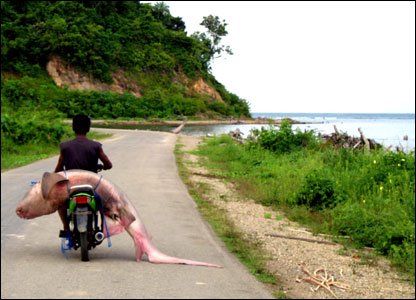
I posted a picture of the garbage the sea was spitting back to Mumbai several weeks ago. I recently found the photo above of children wading through more marine refuse that washed ashore beneath their stilt houses in Papua New Guinea. Both photographs made me sad at the state of this world. People are starting to wake up to the idea of global warming and change their way of living to a greener way of life, but those of us in the Western world don't have the same immediate evidence of the toll we are taking on this earth. We have a long way to go.

Monday, July 16, 2007

At Capacity


It would seem that the ocean has had its fill of our frivolous trash cast thoughtlessly into its seemingly inexhaustible repository. Last week, the currents in the sea around Mumbai, India changed and spat back over 300 tonnes of garbage per day.

Saturday, March 31, 2007

Laundromatto Al Fresco

I come from a family that has always air-dried clothing throughout the year. In the summer, sheets and dresses flap in the wind on a spinning clothesline in the sunny part of the garden. In the winter, they hang from lines erected in the basement and drying racks in the spare room. I was often envious of the Downy-scented sweatshirts of my friends and couldn’t understand my mother’s love of “that fresh scent” that clothes dried outdoors get.

My dad told me that driers use 25% of a household energy bill. According to Project Laundry List, the figure is 5-10%. And although my father and I share the trait of sometimes forgetting to cite the sources of our statistics (which always seem to support our arguments), I would guess that 25% is a good estimate for his household, which has been eco-friendly and energy efficient for decades – so adding the use of a drier regularly probably would constitute about a quarter of his household's energy use.

Project Laundry List is a website dedicated to educating “people about how simple lifestyle modifications, including air-drying one’s clothes, reduce our dependence on environmentally and culturally costly energy sources” (quote taken from Mission Statement). It showcases artists’ interpretations of the beauty of clotheslines, offers links to environmentally friendly products and offers support for communities banned from using clotheslines. I didn’t know this actually was a problem, but Cecily Ross addresses it in her article in the Style section of the Globe and Mail today, where I found the link to the website.


Ross interviews the website’s founder, Alexander Lee, who believes that “a lot of people see laundry on a line as a flag of poverty.” That was certainly one of my reasons for wanting my mother to buy fabric softener and use a drier: all my other friends had slick machines that offered up soft and fluffy, scented clothes, whereas I had to do a couple of squats to get my jeans to lose the stiff consistency of an indoor-dried garment. I felt the odd one out, not keeping up with the laundering practises of the Joneses. When I went away to university, I mechanically dried all of my clothes with abandon; fading colour and losing elasticity in the process.

Fifteen years ago, the environmentally-friendly lifestyle with its patchouli-scented products were the domain of hippies and David Suzuki followers. And people who kept their houses at a lower temperature in winter and used lights only when necessary were considered misers. Now it has become de rigueur to wear organic cotton, use unbleached tampons and clean your house with green products. There had been a huge push for LCD lightbulbs and EnergyStar appliances that use less electricity. I am hoping that this trend will spread to how we clean our laundry: a clothesline of brightly coloured attire flapping in the wind will no longer represent the home of a poor family, but the home of an environmentally aware family.

And everyone, including me, will crave “that fresh scent” that my mother so loves.

Friday, March 02, 2007

How cool is this?

Cargo has just released a lipstick line called PlantLove, the tubes of which are made from a corn derivative that is completely biodegradeable. The actual lipstick does not contain any nasty petroleum (or mineral oil, for that matter).

But I haven't told you the best part yet...


The lipstick comes in a biodegradeable package that is suffused with wildflower seeds, so if you soak and then plant the package, you get lovely flowers!

Thursday, February 01, 2007

Hotter Than I Should Be

It seems that the world may be slowly waking up to the reality of climate change…

In an effort to draw attention to energy consumption, the whole of France participated in a five minute power switch-off, during which the power grid operator reported a decrease in consumption that was equal to 1% of the national consumption. The Eiffel Tower, normally ablaze with 20 000 bulbs, joined in the national campaign by switching off power at 7:55pm. Several other European cities followed suit, participating in country-wide blackouts.

Our own Stephen Harper, who, five years ago, wrote a letter “downplaying climate change”* and then concluded that the greenhouse gas reduction targets outlined in the Kyoto Protocol were unattainable, is now acknowledging what a pressing issue climate change is becoming. George Bush even mentioned the environment in his State of the Union Address by introducing the Clear Skies legislation.

I saw David Suzuki (see his website under Websites That Might Just Change Your Life to your right) speak this time last year about the state of our earth. He spoke of a document that was signed by 100 scientists “greater than [him]” that was submitted to world leaders 10 years ago (I may have some of those numbers wrong – we’re going on my memory here) that outlined the urgent need for the world’s energy consumption to be decelerated. And if we did not do something about the amount of greenhouse gases we were putting into the atmosphere, it was only a matter of a decade or two before most of the earth was uninhabitable. The document was largely ignored at the time.

So why the attention now?

I think it started with An Inconvenient Truth, Al Gore’s documentary about our planet’s shaky future. It was a film by an American for Americans (some of the largest energy consumers in the world) – it was one of their own telling his country where they were going wrong.

And then much of eastern North America experienced a mild December and beginning of January. They were playing golf in P.E.I. Blossoms came out on the trees in Central Park. Meanwhile, the west coast, normally accustomed to mild, rainy winters, experienced some of the worst snowstorms in living memory. And everyone got a little bit uneasy, Al Gore’s warning still echoing in their heads.

What will be interesting to see is if people begin to make changes – even small ones as are listed on David Suzuki’s Nature Challenge – changing lightbulbs, getting out of the car, turning down the heat by 2 degrees. Will people begin to think about alternate forms of transportation, moving closer to their work, eating meat-free meals with locally grown produce more often?

Or will we allow our cars lots of idle time to warm up in this colder-than-usual week in January, all the while mumbling, “Climate change? What climate change?”

*Toronto Star, January 31st, 2007

Friday, May 12, 2006

Cycling in the City

Really, this is what life is all about: mild spring mornings, bike lane stretched out before you, a line of suckers idling in their cars as you sail past. Biking to work really makes you feel good. Not only are you stepping up to the One Tonne Challenge (Oh wait, wasn't that cancelled by the Conservatives? I guess we didn't need clean air in our atmosphere, anyway - oil production is way more important), but you are increasing your heart health and putting those endorphins into action first thing in the morning. Biking is reportedly the best way to travel within 10km in an urban centre (source: Green Living, Spring/Summer 2006): it's fast, it's free, and you don't get caught in traffic gridlock.

And here's one personal reason for biking to work. There is a piece of graffiti written on the road, within the boundaries of the bike lane (on Dundas, just west of Coxwell) that I pass by each morning I ride my bike. It's hard to tell in the picture at right, but the words spray-painted on the road read: "LOVE IS THE MESSAGE". This has provided me with inspiration and melted any stress or anger every morning I pass it. Maybe it's those endorphins, kickstarting my serotonin; maybe it's the fresh spring air; maybe it's the knowledge that I am not contributing to the destruction of our earth. But that little piece of urban poetry is my psalm, my bible reading of the morning that sets me up for a good day. I repeat it like a mantra as I ride over it.

Monday, May 08, 2006

Gardening With the Environmentalists

With spring now in full force (is anyone else always amazed at how fast the city becomes so green?), the gardening enthusiasts of Toronto are lining up at Home Depots across the city to stock up on their Miracle Grow, their pansies and their gardening gloves. However, the one thing that amateur horticulturalists will not be able to pick up from any company this season, is a toxic dose of pesticides to kill off plants that are deemed “weeds” by our fickle society (for what is a weed, but a "a plant anywhere you don't want it?").

Is this really such a political issue that Denzil Minnan-Wong has had to come to the defense of his proud-gardening constituents of Don Mills who, since September of last year, have had to put up with the foul and feral blight of dandelions on their lawns? They ignore the links of pesticides to cancer and allergies, all for the vista of a green, unadultered lawn.

Personally, I agree with Deputy Mayor Joe Pantalone, who likes the yellow-topped herb: “If you like it it’s a flower, if you don’t it’s a weed. I think they’re like the forsythia in a way...one of the first signs of spring.” (see: pulse24.com for full article and a list of organic ways to be rid of weeds, should you choose).


Why do we feel the need to control nature to the point of pouring toxins into our soil for our children and pets to roll around in? Let’s think of our earth and the ecosystems that exist on it, not just the view from our lonely windows.

Sunday, April 30, 2006

Suburban Madness

I have always been interested in the idea of proxemics, first introduced to me in an anthropology course. Proxemics deals with the social construction of personal space – how close we stand to each other and how this changes with the situation. If you’re North American or Northern European, you probably stand closer to a friend at a bar and further away from a client when discussing business. Proxemics also extends to how we construct our space as a culture. North Americans have the “buffer zone” of a front hall when entering a house. In Cuba, the front door of most houses opens straight into the living room.

So I always find it interesting to “deconstruct” how space is used. And a recent exhibit at The Toronto Free Gallery about Suburbia got me thinking about how suburbs use space.

It has been said before, but the suburbs are built around the mighty automobile. My visits to Ajax have shown me outdoor malls where the space assigned to parking lots out-measures the retail space by a ratio of at least 4:1. And these clusters of massive Wal-Marts, Old Navys and Best Buys are set far enough away from the residential masses of cookie-cutter houses attempting individuality through variations in colour and orientation of layout, that a car is “required” in order to “pop ‘round the shops.”

Now let’s take a look at those mass-produced, lower selling price, but-still-accessible-to the-city (by car, of course, or by train, but you have to drive to the train station) houses that dot the suburban landscape. What is the most prominent feature of the house? The sweeping bay window? The detailed brickwork over the door frame? The carefully-placed stained glass in the front room window? No, it’s the garage, front and centre in many suburban houses. And a lot of garages have space for two or more cars. During my time in England, I noticed that garages were not a required part of housing and were often tacked on well after the house was built. As much as they moan, the British have a better and more comprehensive transit system than we do in Canada, therefore houses do not need to be built around housing a car.

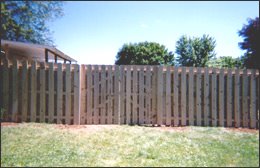
The priority of the automobile aside, it was something different in the Toronto Free Gallery’s exhibition that got me onto proxemics. One piece was an enclosure of six-foot privacy fencing (like the kind shown at left), the inner contents visible only in snippets as you tried to peer through the small lines of open space between the slats. The idea was exactly as the name of the fencing indicates: the attainment of privacy. And when I boldly opened the latch to the installation (still not sure if this was intended), I caught a glimpse of a naked female torso cast in stone.

They say that high fences make good neighbours, a saying that must be uniquely North American/European. I bet the Cubans have a slightly different maxim: easily accessible family rooms with no neutral space make for good neighbours.

Although it probably sounds better in Spanish.

Wednesday, April 26, 2006

April Anniversaries: Not Just Earth Day


(from news.bbc.co.uk)

Today marks the twentieth anniversary of the world's worst nuclear accident at Chernobyl. Pripyat (pictured), once a city of almost 50,000 inhabitants, has sat abandoned since then. It took authorities several days to report the disaster and take measures to keep people safe. It has been years that scientists have been telling governments, the media and the public that our current levels of consumption are putting our entire planet at risk. Are our children to become painted shadows?

Friday, April 21, 2006

David Miller's Clean Sweep Army


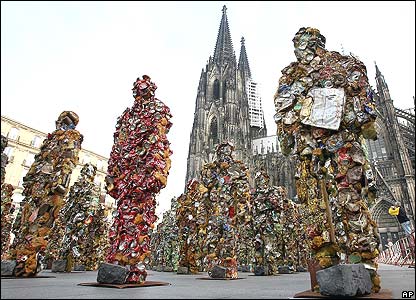
While Torontonians took 20 minutes today to clean up the city, one thousand "trash people" sculptures by artist HA Schult stood outside Cologne Cathedral in Germany.

Does that one on the right remind anyone of David Miller?

(from news.bbc.co.uk)