Tuesday, November 28, 2006

Chick Lit, Revisited

In the November 4th edition of the Globe and Mail, before the Giller prize was awarded to Vincent Lam for Bloodletting & Miraculous Cures, there was a “Giller Debate” between Andrew Gorham, Sandra Martin and James Adams. They discussed the merits of the shortlisted books and debated which one might win the largest annual prize awarded for fiction in Canada.

Out of all the books on the shortlist (De Niro’s Game, The Immaculate Conception, Home Schooling and The Perfect Circle all lost out), The Perfect Circle appealed to me the most (see "I'm Reading..." in the sidebar of this blog). What was interesting in the Globe article though, was the fact that the two men didn’t see the book as a contender:

“Andrew: Now, let’s talk about Quiviger’s The Perfect Circle. First off, and maybe this is sexist, I feel that half the reading population is removed because it’s very much a female love story.

James: You mean, it’s chick lit.

Sandra: It’s not chick lit.

Andrew: It’s great chick lit.

Sandra: It is definitely not chick lit. It’s not chick lit.

Andrew: It’s a love story and, as a man, I prefer something with a little bit more…

Sandra: Action.

Andrew: Contention.”

Mr. Gorham implies that a book dealing with relationships does not have enough substance to qualify for literary recognition.

Really?

In a previous post, I tried to delineate the dismissive term “chick lit” and decide why Sophie Kinsella is stamped with the label but Margaret Atwood is not. The difference, I found, was the inclusion of “weightier” topics within the female experience of love.

But can we really discount love as a trifling subject? Women and men have written about it through the ages – it is the most popular topic in poetry and song. Humans make their living arrangements and reproductive choices (usually) based on love. And when love is taken away, we plumb the depths of emotion.

Michael Ondaatje, widely considered a “serious” author and also the winner of the 2000 Giller Prize (for Anil’s Ghost), writes the most unbelievably amazing prose describing romantic love in the chapter entitled “Katherine” in his novel The English Patient – which won him the Booker Prize. (If you haven’t read it, go read it right now. If you have, re-read it.) The English Patient is thick with the nuances of demarcation and national identity, but it would have won on the merits of its prose alone. So why does Gorham discount The Perfect Circle based only on its subject matter?

The truth is, it is only one man’s opinion. The Perfect Circle made it to the shortlist for the Giller on its literary merits, regardless of subject matter. Quiviger’s words are evocative; her style both languorous and obsessive, like those first heady weeks of a love affair. And what is great literature, but the containing of human experience into a few well-chosen words that make the reader think, ah yes; that IS how it feels…

Wednesday, November 22, 2006

Proof That Someone Other Than My Mother Reads This Blog...


I have acheived the first step in my quest for Web (and eventually Literary) domination thanks to PubStumpers, who have posted my Pub Quiz post.

Saturday, November 18, 2006

Guess the Occupation


For those of you who made guesses for the Surreal Sea Nymphs, they were actually a bunch of Australian school girls celebrating the end of exams. Now put your brains to this test: what is the man in the picture's occupation?

Tuesday, November 14, 2006

Ward’s Island, November 3rd

Lyla snuggles her face into her scarf as she puts her mittens back on after taking a picture of Max. His body is still, sturdy legs planted among the browning leaves, watching birds through his binoculars. His coat is undone and Lyla hasn’t seen his mittens on his hands yet. Amazing, thinks Lyla. Children never seem to feel the cold like adults. Her hands took only a few seconds to become cold and stiff on this unseasonably cold day in November.

“Aren’t you cold, love?” she asks Max.

Max twists his body, led by the over-sized black apparatus he holds at his eyes, following something aloft that she can’t see. He then brings the binoculars down and looks at her.

“Nope,” he says, then steps out of his stance and heads for the trail.

“Ironman,” says Justin, smiling. “Must be a Palmer.”

Lyla smiles and falls in line behind her brother, following the well-worn path through the trees.

When they get to the clearing, Max stops and turns around.

“Here, Dad?” he says, eyebrows raised.

Justin reaches into his coat pocket and pulls out a plastic bag of birdseed. He empties a small amount into Max’s outstretched palm, then offers Lyla some. Justin takes some for himself, then replaces the plastic bag.

“Now remember, stand by a tree and be very still,” he instructs Max.

The three of them stand in a haphazard line just off the clearing, arms outstretched with the proffered gift. Within a few seconds, the first chickadee, small and grey with its little black head, lands on a branch close to Justin. It hesitates momentarily, then swoops into his palm, nabs a seed, and flies away.

“Awww!” says Max. “How come it won’t come to me?”

“You have to be very still and very quiet,” says Justin.

We stand in silence for several seconds until another chickadee lands on a branch near Justin.

“Here we go,” he murmurs, moving his palm slowly toward Max’s.

The bird hops from branch to branch, trying to determine the best approach. As he gets closer and closer to the outstretched hands, Justin curls up his fingers, making a fist around the birdseed. The chickadee darts closer to Max, swoops down, and lands on Max’s hand.

Max’s eyelids flutter in surprise, but he remains still. Lyla watches a smile break across his face as he feels the light tickle of the chickadee’s feet on his fingers.

After it pecks at a few seeds, the chickadee zooms away, becoming camouflaged in the grey branches of the surrounding trees.

“Did you see that, Auntie Lyla?” asks Max. “The chickadee came to me!”

Saturday, November 11, 2006

Thursday, November 09, 2006

57 Channels and Nothing On


I lived for the first 12 years of my life without cable (on a black and white television). When my family finally got hooked up (we were cable subscribers in the generation after the tan box with the push buttons), I developed a nasty habit of starting at channel 2 and clicking upwards to the last channel that the cable provider would allow. Finding nothing interesting on (as in the words of the Bruce Springsteen song, referenced in the title of this post), I keyed in channel 2 again and repeated the whole process. I could easily spend an hour with the TV on, but not actually watching anything.

When I moved in by myself, I brought with me my grandparents’ 13-inch TV and accompanying bunny ears, partly out of impecuniousness, but partly out of a desire to not spend hours not actually watching television.

But the other week, my old TV blew a picture tube and it was time to buy a new TV. Which did not come equipped with bunny ears attachments. So I buckled and signed up for Rogers Digital Cable.

I don’t think I could even estimate how many channels I get with the basic cable package – partly because I haven’t found them all. I’ve only made it up to the hundreds. And in those hundreds are a lot of Simpsons, Friends and Seinfeld reruns. Often the same episode running on several different channels. And then an hour later, you can watch the same episode again, but from a Manitoba channel.

And the home renovation and decorating shows – my god, is there no end to them? I thought we’d been oversaturated with reality shows. Obviously I hadn’t been watching daytime television. Soap operas and talk shows have been taken over by a plethora of shows hosted by women in overalls and men toting around swaths of fabric to make into curtains.

So those are the drawbacks. What about the positives?

Well, I can watch Oprah now (on a Manitoba channel). I have a vast selection of sitcom reruns to watch as I make dinner. The TV doesn’t go fuzzy on rainy days.

And my knowledge of home renovations has never been better…

Monday, November 06, 2006

Who I Love and Must Attend To

I wrote a previous post about Who I Hate But Must Attend To. Upon reflection, I feel that I need to balance my disapproval and criticism with some glowing praise and support of some people in the radio and print industries who I love:

Doug Saunders

I don’t know how this man keeps all his knowledge of current world politics and the histories of what seems like three-quarters of the countries in the world in his head and available for easy retrieval. His weekly column “Reckoning” in the Focus section of Saturday’s Globe and Mail dissects the current political climate of various countries, his writing infused or contrasted with the histories of various nations. Saunders takes current events from around the world and analyses them with a critical, and often Canadian, eye (despite the fact he has been transplanted in London, England). His writing often makes me think and always causes me to learn. Saunders’s column this week asks the question if the well-intentioned architecture and design of the suburbs of cities such as Paris contributed in some way to the unrest among its young, foreign-born inhabitants.

Barry Taylor

My favourite thing to do on the weekend (after sleeping in, of course) is to have a coffee, read the paper, and listen to Barry Taylor on 102.1 from noon onwards. Taylor has a relaxed attitude and a keen understanding of the brevity of wit. His show entails a series of spots, including the Barry Funny Joke and the 4:20 Thought, along with the music that the Edge is known for. He also has all sorts of random sound bites that follow the spots, which fans come to anticipate. On the Edge website, Taylor lists his hobbies as video games, drinking and making out.

Friday, November 03, 2006

Monday, October 30, 2006

Comics on the Fridge

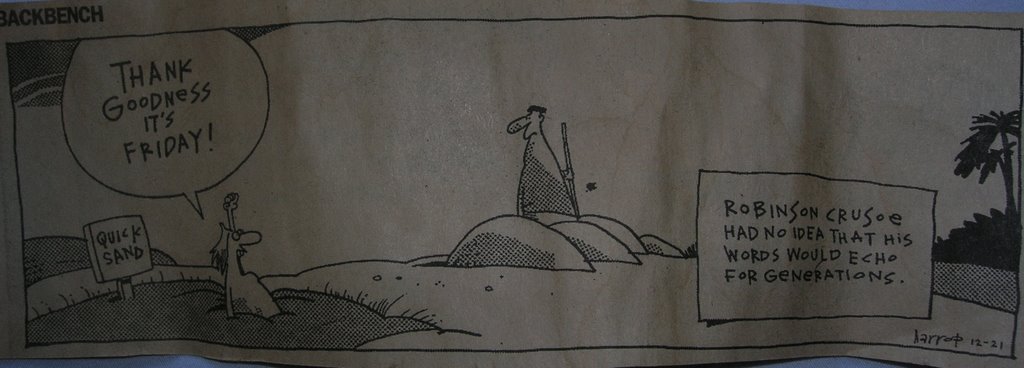
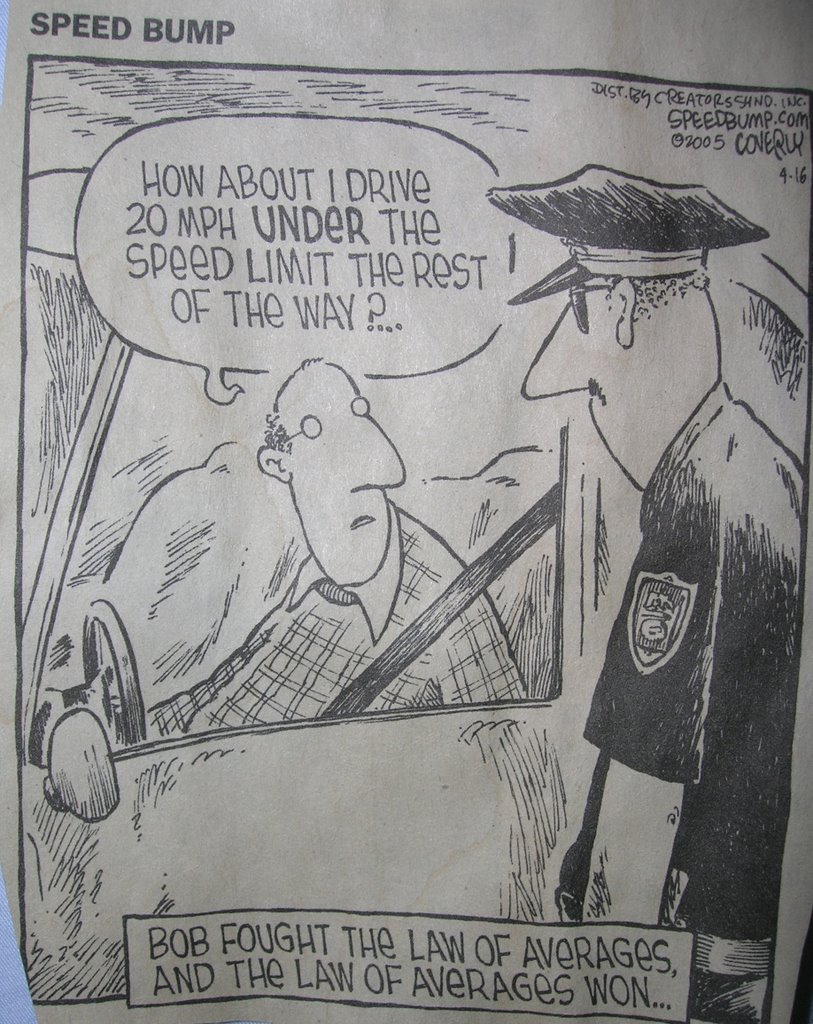
What makes people seek out the kitchen scissors (why are they not in the drawer where they should be?) and cut out a comic from the newspaper (oops, forgot to check what was on the other side and now there’s a swath cut through the article on rebuilding Israel that I had good intentions of reading)?


I had this thought as I cut out the above comic from the Toronto Star today. Why this one? And why did the comics below make it to my fridge, displayed in perpetuity, garnering smirks as I reach for the milk, and not fade from my memory as I curse the 4 flights of stairs I must negotiate while taking the comics, along with the rest of the unending piles of newspapers that seem to pile up at an astonishing rate, out to the recycling bin?


Well, first of all, they're clever in a cerebral way. Not in a "oh, isn't that cute?!" Family Circus kind of way. They require the merging of several areas of knowledge: Stonehenge and its celestial precision and Daylight Savings; the story of Robinson Crusoe and the pop culture phrase shepherding the weekend; laws of probability and songs by The Clash.

Second, by residing on my fridge, they represent me as intelligent and clever - I was sage enough to understand, appreciate and subsequently cut out the comic. So anyone that casts their eyes across the disarray that is the front of my fridge, immediately reads me as insightful and canny.

Well, either that or I know where to find the scissors...

Saturday, October 21, 2006

Avoiding the Gaze - update

I just picked up the November issue of The Walrus and there's a photo essay of women wearing "safe" and "sexy" outfits, explaining the reasons for their choices. No photos of burqas, though...

Avoiding the Gaze

I had a conversation recently with a friend of mine who was entreating me to take the subway downtown so that we could have a proper night out. I was stuck between the decision of driving, therefore cutting down the travel time by half, but limiting my alcohol intake (and thus the severity of a subsequent hangover); or taking the TTC so I could quaff indiscriminately (after a later arrival, of course).

But the time and the drinking did not factor into the decision making process. My major concern was the feminist idea of the male gaze, identified in movies and magazines, but also observable in any public area.

In general, I find that I can blend into the masses of people on a streetcar or on the subway in the day. People are reading or chatting or listening to music. I am often doing the same. But taking public transit at night as a single female is a slightly different experience. One becomes very aware of the male gaze and all the complex power realationships that it involves.

In her Saturday column in the Globe, Karen von Hahn touches on the male gaze and its relation to the niqab (a type of veil worn by Muslim women), after British Cabinet minister Jack Straw stated that the veil is a "visible statement of separation and of difference" and asked women visiting his doctor’s office to consider removing it. Von Hahn asserts that the niqab makes a “fashion statement” beyond its original religious purpose based on its colour and the degree to which it conceals the body.

However, Straw’s comment about "visual statements of separation and difference" can be applied to myriad styles of dressing, and not just religiously based ones. Goth-style dressing is the first statement of separation and difference that comes to mind; so does the punk style or any kind of anti-establishment fashion movement based in politics. And more often than not, these styles are mainly worn by teenagers who are going through a stage in life where they are questioning authority and attempting to find their place in society.

I’m a little less political in my dress. When I “blend in” on the TTC, it is often because of several “fashion” factors: I wear jeans, a ubiquitous dress item; I usually wear sunglasses, concealing my eyes from any chance of eye contact with others; and I often listen to my iPod, the earphones making the loudest (ironically) statement that I do not want to engage in any social contact. I send out strong signals that I don’t want to be looked at or participate in any kind of interaction.

This becomes more difficult when my demeanour says something different when on my way out to a social event. I have no sunglasses (usually it is nighttime), no iPod (don’t want to risk losing it) and the jeans have been traded in for a slightly more “polished” outfit (this is when the H&M impulse buys make their debuts). While this style of dressing is completely appropriate for a social event with my peers, it facilitates the unwanted male gaze on the transit system. Hence my reluctance in the aforementioned conversation with my friend.

So can we blame the Muslim women that von Hahn references in her column who “claim relief from the oppression of the male gaze”? Do the various Muslim headdresses allow women to “blend in” as my daytime uniform on the TTC does? Or do we see any piece of clothing as a “continual manifestation of intimate thoughts, a language, a symbol” as von Hahn quotes Balzac in her piece?

You can’t escape where symbols originate from or the process of how they come to mean something. But this is where knowledge and freewill come into play. If Muslim women are given the choice to wear a headdress, and they choose to do so, that is their prerogative. If wearing a niqab or burqa makes them feel less conspicuous and more comfortable, then why shouldn’t they wear it? I see a problem arising when women are not given the choice, or when a politician interprets a "fashion statement" with limited knowledge of the full symbolism and function.

So what was my travel decision for my social engagement that night? I made a "visible statement of separation and of difference" by driving my car, my entire body hidden inside my car and my face somewhat obscured by the reflection of streetlights on the dashboard. I felt comfortable, I felt safe. And I felt a hell of a lot better the next morning for the modest amount of alcohol I drank.

Thursday, October 19, 2006

The Love That Dare Not Bark Its Name

Oh, those open-minded Scandinavians with their liberal views on sexuality and toplessness!


The Oslo Natural History Museum in Norway has opened an exhibition of photos depicting animals engaging in homosexual activities.

Even better is the reaction from the political right which has said that the exhibition is "propaganda invading the scientific world" and that the organizers will "burn in hell".

Perhaps by "burn in hell" they mean "sweat vigourously in a free state of nakedness, stretched out in a sauna somewhere in Stavanger, perhaps indulging in a litte whale meat and man-love".

(And to my astute biologist readers, yes, the picture in this entry is actually heterosexual sex. But, somewhat surprizingly, it is actually quite difficult to find G-rated homosexual animal sex on the internet.)

Sunday, October 08, 2006

Confessions on a Market Stall


I can't believe there's a second photo of this sort out there (see first). Who buys these? (Is that Putin in the background?)

Friday, October 06, 2006

The Annex, September 28th

Lyla leans back in her chair and crosses her arms across her chest, taking in the boy who has just walked past her table. He walks with a familiar smoothness, his eyes focused beyond the heads of the people sat around the tables that fill the room: a man on a mission. His slim, muscled shoulders are visible through his tight-fitting T-shirt and Lyla lets her gaze drop to his waist, the band of his underwear visible above his jeans.

His hair is slightly disheveled, a style that probably took him 15 minutes and a whole lot of that molding mud he used to use. His eyes do not pass over Lyla, although she’s sure he’s seen her, scoped her location the minute he passed through the door.

He greets another guy at the bar, shakes his hand and smiles his coy, closed-lip smirk he employs to keep any overt emotions in check. He casts a glance over his shoulder, mid-sentence, his eyes not quite meeting Lyla’s.

He is still the irresistible, unattainable bad boy that Lyla met 5 years ago. It was his aloofness that first attracted her. Well, that’s not true. It was his brown eyes that first attracted her. It was his detached demeanour that intrigued her. There’s nothing like a boy who doesn’t want you...

Throughout their brief courtship, which consisted of long spaces of time between phonecalls and run-ins at the bar where it seemed that he was only then reminded of her existence, Lyla fantasized him into a good boy. He became a boyfriend who would watch movies with her on a Friday night, someone who would cook her dinner and drive her to yoga class. Someone who would fall in love with her.

Funny, how we do that, she thinks, arms still crossed warily across her chest; how we rise to unachievable challenges in love.

Her pint arrives, delivered by a short blond waitress, someone who, she has found out through the grapevine, has been his latest conquest. Lyla thanks the unknowing blonde girl and uncrosses her arms to reach for the glass.

Lyla has her eyes on him as she brings the beer to her lips. Just then, he turns his head and locks eyes with Lyla. A rush of adrenaline surges through her, starting in her chest. She can actually see him consider whether or not to acknowledge her. And just as his face warms into a smile, the bartender taps him on the arm and his attention is pulled away.

Lyla swallows the bitter-tasting beer, places the pint glass on the table, and leans back in the chair.

Monday, October 02, 2006

Autumn in Toronto

*

Summer remains my favourite season, but I am really enjoying autumn in Toronto this year. Trees gradually taking on their warm-hued colours: reds and oranges and yellows, the leaves fluttering to the ground in gusts of wind that hint at chills to come. Glorious, sunny Sunday afternoons where all there is to do is brunch, stroll along Bloor, then perhaps head home for a nap. I’m even loving the rainy Saturday afternoons, the air edging toward mild, the rain providing a gloss for the fallen leaves that pepper the sidewalks...

(Image from http://owlfish.com/weblog/2004/10/archive.html)

Saturday, September 30, 2006

Guess the Sport III


What sport are these men playing?

Hint: It is a slightly decelerated version of the original, with, perhaps, not so many royals milling about.

Thursday, September 28, 2006

The Break Up

For 20 euros (about $30), a German “separation agency” will phone your spouse/partner/lover to tell them that you no longer want to be with them. For 50 euros ($70), they’ll do it in person.

Oh, man! This is the get-out-of-relationship-free card that Jerry Seinfeld advocated in his stand up routine! How nice would it be to finish with a failing relationship in one easy motion (like a band-aid – right off!). There could be no long, drawn out conversations about where you went wrong, no forced falsehoods about how it’s not you, it’s me (it’s totally you), and no awkward explanations about why you stopped liking someone because of the way they punctuated a phone message (ah, Elaine…). For the price of a good bottle of wine, you can be free of the guilt and uncomfortable atmosphere that a break-up conversation evokes.

But really, do we need to pay for this? Surely there are cheaper ways to split from a partner. However each break-up method has its social rules…

PHONE-CALL FADE-AWAY

Involves, rather simply, just not calling someone back. Easy, low-stress and should be picked up easily by the undesired partner. Perfectly acceptable in the first month of dating. If being let go by this method, you are allowed one (1) phonecall after the first unreturned phonecall (to allow for undelivered messages etc.). After that any contact within a 6 month period is unacceptable.

TEXT MESSAGE OR E-MAIL EXPLANATION

Not really cool unless the partner you are trying to dump is proving hard to shake. If he or she doesn’t get your subtle hints (see PHONE-CALL FADE-AWAY), perhaps a written explanation in the “it’s not you, it’s me” genre is required. Do not attempt this method of separation if you’ve been together for several months (see FACE-TO-FACE).

FACE-TO-FACE

Required if you’ve been dating regularly for two months or more. Should be done in a public place that offers some privacy so that a) dumpee can’t go mental on you and, b) dumpee crying won’t cause a scene. Not acceptable on Valentine’s Day, dumpee’s birthday or any major religious holiday. Amount of time acceptable to spend discussing the relationship and where you went wrong can be found by taking the number of months spent together, multiplying by 20, then converting that number into minutes.

And of course, never forget the formula that Charlotte from Sex and the City employed after a break up: it should take exactly half the time you spent in the relationship to get over the person that dumped you. (This, of course, is only applicable to women. The men’s formula for time spent getting over someone is a quarter of the time spent in the relationship.)

Phew. When did this get all so complicated? Maybe the German company is onto something…

Wednesday, September 20, 2006

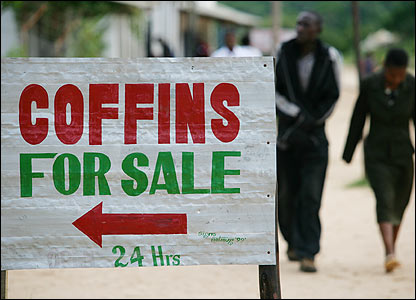
Zimbabwe Business


Death is one of the few growth industries in Zimbabwe due to the number of people dying of AIDS.

Saturday, September 09, 2006

Now I’ve Heard It All…

In the sleepy county of Cornwall in England, police have served a man with a notice for "placing a garden gnome with intent to cause harassment".

Stop for a minute. Re-read that last sentence again. Okay, continue.

Apparently the gnome is solar-powered and lights up at night, annoying neighbours and upsetting potential home buyers in the area. And I thought I was uptight…

Gnome Story from bbc.co.uk